Dear Lord Darzi,
I’m an SHO – sorry, CT1 – and have never had any inclination to become a GP. Hence, in my somewhat selfish way, I disagreed with, but largely ignored, your infamous polyclinic plans. Yet two funerals I attended this year brought into sharp focus why I, and thousands of doctors, feel polyclinics are a step in the wrong direction.
My mother’s younger sister met her husband at medical school in India and mirroring countless similar couples, came to the UK in the 1980s to start a family. Both worked as hospital SHOs for a time before becoming GPs in the north of England.
My aunt stayed at the same practice for many years, becoming a fast favourite with patients due to her caring nature and comforting smile. She raised my two cousins, the eldest of whom is now an F1. My uncle also excelled in his career and expanded his practice immensely. He pioneered many new initiatives, sat on various committees but never forgot his priority was his patients. His devotion to their care won him a profile in the Daily Mail as ‘Britain’s favourite GP’; secretly nominated by patients and staff. He found the whole thing embarrassing.
Both would routinely go far beyond the call of duty for their patients. Yet they would be the first to tell you that they were not exceptions. Their dedication to care, the relationships they built with patients and their place in the community is shared by GPs across the UK. Genuine family doctors.
Their diagnoses of two different cancers came years apart, but they died within three weeks of each other this summer. They were in their mid-fifties and desperately tried to keep working as long as they could. Both felt most comfortable in an NHS hospital when unwell.
I organised both funerals in the same crematorium. Its capacity was one hundred and on both occasions it was filled more than twice over. I enjoyed chatting to patients who simply felt ‘they ought to be there’. They emphasised how they regarded my aunt and uncle as honest friends, who they confided in, trusted and who never hesitated to tell them the truth.
A tall man with long hair, tattoos and a leather jacket, smiled when he thought about my uncle’s place in his life:
“I’ve had seven children, three wives and four houses...Dr X has been the only constant in my life!”
It is this one line that makes me fearful the British public’s relationship with their most important doctor will change forever.
My cousin wants to follow in her parents’ footsteps as a general practitioner. I want her to be able to experience the lasting relationships with patients my aunt and uncle did. I want her to be a constant in their lives.
Labels: medicine, NHS, polyclinics

THE geniuses behind Medical Student Newspaper have produced some essential reading for all final year medics in the UK, in conjunction with doctors.net.uk. Quack contains all the knowledge one needs to apply for a Foundation post and more. Join the Facebook group.
My contributions included updated versions of stethoscope psychology, depraved revision, a breakdown of the MTAS saga and the WISE words below.
By the way, Medical Student Newspaper has won yet another award nomination. It is in the running for the Best Student Newspaper in the country at this year's Guardian Student Media Awards. Every year since the paper's inception has brought some silverware; fingers crossed.
How to be the coolest, most pimped-out, badass FY1 at your hospital
What you need to know as a first year doc and what you haven’t been told
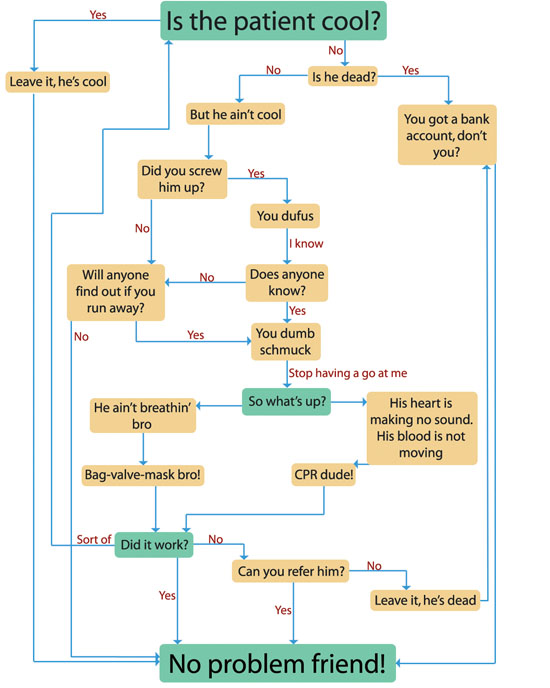
The most up-to-date Advanced Life Support (ALS) algorithm. Use this at any stage during your Foundation Years; acutely unwell patients will be a common encounter and you should feel confident in determining whether a patient is cool or whether they need your help. If unsure, feel free to ask “are you cool?” Don’t be afraid to tell your patients to BE COOL.
There is no one way to be a good FY1, or house officer, as you will still find yourself referred to. However there are certain hints and tips that can be imparted by those that made it through. Intact. Unscathed. Ready to fight another day. ONWARD!
First and foremost, your first year as a doctor should be about enjoying yourself. Never forget this. There are many similarities to life at medical school; you will probably live in halls, go out too much and make lots of new friends. The only real differences are that you can’t bunk off anymore, but you do get paid.
The single greatest fear of a new doctor is that they will do some harm to a patient. This, whilst not impossible, is improbable. The reason being that you have spent four to six years learning how to do the opposite.
You are so imbued with misplaced self-doubt when you start working that you end up being over cautious. This is normal. Don’t worry about making mistakes, just concentrate on enjoying yourself and the rest will flow.
Perhaps the one gem of information I wish I had been given before I started was that you did not need to be top of the class at medical school to succeed in your first year of work.
In fact, where you ranked has no correlation whatsoever to how you will perform and you should put it out of your mind entirely.
If the comparison of FY1 to medical school can be extended, then the first week is Freshers’. With most junior medical staff now starting at the beginning of August every year, the hospital will be atwitter with introductions and nice-to-meet-yous when you start.
The first few days are rarely taxing. They normally consist of induction talks, orientation sessions and a gradual easing into the job.
You might turn out to be one of the unlucky punters that kicks off work with an on-call. Daunting it may be, but on-calls are fantastic learning opportunities. Asking for help is something you should never be afraid of doing in your first year. People will fully expect you to ask the most inane of questions, even if you feel like an idiot. Get over that embarrassment and ask – better that than goofing up something easy.
There is also no shortage of people to ask. Obviously your immediate seniors are a logical first step, but the resource you will invariably draw upon throughout your junior years is the nursing staff. If you take one piece of advice away from this article, make it this: be nice to nurses.
Nurses can make your life so much easier if you acknowledge their existence and value their contribution, and they can equally give you grief if you piss them off.
Nurses, like anyone else, don’t like being talked down to by snooty doctors. If you’re not sure what fluids to write up, or what the dose of metoclopramide is, asking a nurse is a good first move.
Having said that, nurses go through a learning process too and might be just as green as you. If you’re unsure about any advice given, there’s no harm getting a second opinion. You will find that the ability to know what is duff advice and what is good sense develops quickly and naturally.
A further word about those nurses. Most FY1s will be ward-based and whilst it is useful to be nice to nurses on-call, it is imperative to establish good relationships with the nurses on your own ward. They can be inordinately helpful if you’re mates. Not to mention that if you can have a laugh with the nurses, social workers, ward clerks, physios, OTs, HCAs or medical support workers on your ward, your job will all the more fun.
This provides a convenient segue onto what is likely to be the bane of your life during the Foundation Programme. Assessments. You thought tick-boxes and form-filling ended with graduation. I laugh at your foolishness.
Working well with those around you will stand you in very good stead for a key part of your overall assessment, the min-ePAT. Out of all the nonsense you are forced to complete in your first year, this is a very useful exercise.
On two occasions you are required to nominate twelve co-workers, of whom only a limited amount can be doctors, to anonymously say what they think about you. As you can imagine, the ability to be frank allows your colleagues to give you what can frequently turn out to be valuable advice.
All that need be said about the rest of your assessments is that the sooner you get them out of the way, the better. Try not to leave yourself a week to get all the forms filled in, it is no fun.
To reiterate, it is imperative you concentrate on having fun in your first year. It comes only once and just about every doctor you meet looks back on their house officer year with great nostalgia and fondness. No amount of hints and tips from seniors will replace your learning-by-doing, so try not to be wallflower.
If something that interests you is happening, be it inserting a central line or an appendicectomy, try to get involved. Be in the right place at the right time, but don’t be a dick – share out opportunities with friends.
Developing confidence comes far more easily to some than others, but ultimately the only occasion it matters is when a patient’s health is in question. If you are seeing someone in A&E or on the ward and you are unhappy about something, never worry about ‘bothering’ your seniors. Whilst it may be surprising to some, no one will criticise a new doctor for being too safe.
Lastly, if you are one of those keen young things that wants his or her name in lights, your first step would be to leave medicine. However if you want to stay, you might want to consider getting involved with an audit, a presentation or two (most hospitals expect a Grand Round presentation from all the juniors) and if you’re extra ambitious, a publication.
Having said all that, none of these are necessities. The only compulsory objectives for an FY1 are consolidating your medical knowledge (it’s up there somewhere, even if it doesn’t feel like it), seeing patients, getting organised, using your hands, extra-curricular high jinx and wild japes. These are integral to being a good doctor. Good luck and get ready to work like a HO.
Originally published in Quack: Foundation School Guide.
Diagram inspired by ALS guidelines and a flowchart from Antarctica, by Kim Stanley Robinson.
Labels: junior doctors, medicine
My regular column in Medical Student Newspaper has been reprised this academic year. This year it is, of course, 'F2. Woohoo.' Originally published in the October issue,
I’M CANCEROUS. Yes that’s right, I’m back for a fourth year running. This year, I come to you from the dizzy heights of the most superlative foundation doctor there is, THE MIGHTY F2.
A new generation of fresh-faced F1s replaced me and all my ilk. Now I’m supposed to know shit, you know, and stuff.
A&E’s a funny place to work. Over 90% of you will spend four months ‘on the medical front line’ as I am now. Unless you choose to pursue this field (ya crazy fool), your A&E rotation will be the job that brings you more excitement, boredom and frustration than any other. Mostly frustration.
No longer is the emphasis based on diagnosis, which is what draws so many into medicine, but on exclusion. Can you send this healthy 30 year-old chap home...are you SURE he hasn’t had an MI? Let’s refer him to the medics for a twelve-hour trop and take up a hospital bed just in case. It’s mind-numbingly un-stimulating at times.
There are many positives about working in A&E. Exposure to a wide range of problems, dealing with genuine emergencies, seeing instant results. My particular hospital has four great consultants and as St. George’s is a Centre of Excellence for countless specialties, I see some crazee sheeyrt.
However the one overwhelming negative is that it is A&E. There is no area of medicine that has been toyed with by the government as much as the emergency department.
Because waiting times are so easy to quantify and brag about before an election, A&E is a convenient place to pull numbers from. It is also one of two first points of contact for patients. The other is, of course, general practice, which has been tinkered with almost as much, chiefly to the detriment of A&E departments.

The ridiculous lack of sufficient out-of-hours GP provision, NHS dentists, the creation of stop-gaps like NHS Direct and obscene waits for GP appointments mean we are inundated with complaints that are neither accidents nor emergencies.
Yet each person that attends A&E has to be seen, diagnosed, treated and moved out of the department in four hours.
As all five Rohinplasty readers will know (it’s going up), I am obsessed with a solid evidence base. I use that as a chat up line sometimes. Anyway, one would like to think that those responsible for these four hours used all the available data to construct a sophisticated model of a working A&E and thus extrapolated a suitable figure.
The truth is probably more along the lines of pin-the-tail-on-the-number, with an arbitrary figure being plucked from the air.
The reality is a shambles. Of course no standard duration can be applied to A&E patients, as there is no one type of A&E patient. Some are out within ten minutes but some need several hours.

A far more sensible system, as I’m sure an honest government would concede, would consist of clinicians deciding how long each patient needed to be safely dealt with.
However politicians make decisions, not doctors, so that ‘four hour waits’ can be political weapons.
Only 2% of patients are allowed to ‘breach’.
I figured, like many others, a cavalier attitude was the way forward and thought I would ignore breaches and put the patient first. The NHS doesn’t work that way.
Unwell patients often need to stay in A&E until they are stable enough to be transferred. Pissheads need to sober up before they go.
The Medical Assessment Unit, or MAU, that most of you will be familiar with by now, owes its existence to the four-hour-wait. MAUs were created to stop the clock. The vast majority of patients admitted to a hospital come under the care of the general physicians. Hence all medical patients now go to MAUs where there is no timer.
There is no guarantee they will be adequately treated by the time they arrive there and there is no guarantee they will be seen by the doctors looking after them, hence negating the entire reason for the four hour rule.
I must be careful with what I say about my employer, so suffice it to say that unfortunately cooking the books MAY OR MAY NOT OCCUR at SOME hospitals around the country. Will that sound sufficiently vague in court?
Picture the scene. A patient needs a urine dipstick to make a diagnosis of a UTI. However a nurse is off sick and the nursing staff is over-stretched. No one gets the urine sample. The patient breaches. If this breach were recorded perhaps management would see that missing nurse’s value.
However if the number of breaches is the same as on any other night, the hospital realises she’s unnecessary and sacks her. They congratulate each other on more money saved. The system is broken, nothing changes.

We have some bizarre A&E mentality now that stipulates the customer is always right. But the patient is rarely first.
Nurses will drive you slowly mad with a phrase you will quickly grow tired of, “come on, your patient’s about to breach.” I normally cave.
Title reference to Nine Hours to Rama.
Labels: A+E, medicine, NHS, Rohinplasty articles
Originally published in the June issue of Medical Student Newspaper.
How can you ETHICALLY suggest anything for your patient without trying it for yourself? Following a long line of self-experimenting medics, I enlisted some help to make sure I was doing right by my patients.
IT all started last summer. My good friend Froy (star of the October Rohinplasty) and I had been consuming alcohol whilst watching the blasted World Cup. Soon afterwards we found ourselves re-enacting Streetfighter II on Richmond Green.
Normally I am Ryu and a sure-fire victor. Perhaps it was the Cobra I had been drinking, but I chose Dhalsim this time; Froy was Zangief. One spinning pile-driver later and I was in West Middlesex Hospital demanding morphine for my dislocated and broken thumb.

They appeased me with nitrous oxide. Despite Froy inhaling far more than me, void of any injury that he was, we took it upon ourselves to learn about more of the things doctors prescribe for patients.
By the way, nitrous oxide is truly a wondrous trip. I thoroughly enjoyed my analgesia, even though I had to wear a vomit bowl on my head to stop those goddamn bats getting at my hair.
DIETARY SUPPLEMENTS
We ask for dietitian input frequently at St. Peter’s, chiefly because two of them are hot. Apparently they also supply food things for lazy patients. Lazy? That’s my middle name!

Fortijuice: “A distinctive aroma and a refreshing initial tang. However marred by an iron-y aftertaste, somewhat remeniscent of blood. Goes well with hospital hotpot, but a shameful 150kcal per bottle makes this drink a disappointing 2/5.”

Did you look at Fortijuice and think “looks like some good shit, but I want it as a mousse?” Well damn this is your lucky day. It would be if Forticreme - the gelatinous equivalent of Fortijuice - wasn’t such a revolting pot of quivering horrors. A sad 0/5.

I’m an unshamed fan of Scandishake. Available in the holy trinity of milkshake flavours but the strawberry stands out. A light, tasty whip of calories and vitamins, the fact you have to mix it yourself only adds to the outrageous fun. With a healthy 600kcal per shake, its real plus is it supplies 70% of the suggested saturated fat intake in one easy glass of goodness. An effortless 4/5.


Calogen is the undisputed gangster in the wild world of dietetics. Reading the nutritional info is enough to strike fear in the hearts of most men, with 250ml packing almost 5000kJ. Upon corking the bottle, one is greeting with a welcome bouquet of strawberry triglycerides. A curious mercury-like surface tension causes it to remain on a spoon when held upside down, but the taste is laced with surprising velvet, supported by a bra of marshmallow. 5/5.
FLUID REPLACEMENT
If you’re anything like me, you’ve spent hours on end wondering what IV fluids actually TASTE like. We took the Rohin & Froy (double) blind taste test. Saline vs dextrose vs gelofusine.

I chose gelofusine. I did this quite deliberately, it was obvious from its darker hue, because I really wanted to drink a COLLOID. Little did I know, I already had - Calogen is a fat emulsion. Somehow I wish I had not gulped the gelofusine with such gusto. I’d imagine this is what man juice tastes like. Remind me to ask the nurses later. Taste: 0/5.
Froy samples an old favourite, normal saline. Although not with any KCl though, that would be weird. “Saltier than a salty sea dog that’s been sailing on a sea of salt in a giant salt shaker with a hull full of salt, who’s just overdosed on salt because he ate some salted peanuts that were salty but not salty enough.” Salt value: 5/5. Taste: 0/5.
PROCEDURES

Cannulation is one of the most common procedures patients undergo in hospital - it is a popular way of getting MRSA. I started with a pathetic blue but then steeled my resolve and chose the green venflon, as not only did it complement my yellow T-shirt nicely, I was attracted to its impressive flow rate of 120ml/min.

Sweet mother of God, I never realised how much this hurt. Maybe due to the fact I was cannulating myself, but something made this excruciatingly painful.
However the pain was relieved by a sensation I recommend to anyone - a big flush of refridgerated normal saline. If I took heroin, I’d definitely put it in the fridge. If. Pain rating: 3/5.
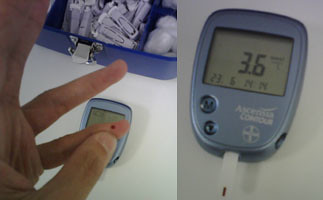
BM testing. This is so painless I can’t even be bothered to write about it. It’s lame, I don’t get why people do this. Who wants to know their blood sugar? Boring! Pain rating: 0/5.
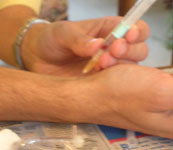
People always seem to moan about ABGs over venflons. As far as I can tell, it’s the other way round. I enjoyed seeing my arterial blood fountain out into a syringe. I quite fancy an angiogram now. Radial approach, wooo! Pain rating: 2/5.
THINGS WE MIGHT HAVE TRIED. MIGHT MIGHT MIGHT.

Morphine is a powerful and dangerous opioid analgesic and sedative. It can cause respiratory depression, itching, and constipation. Froy and I are off to spend the rest of the afternoon lying in the sun watching cricket.
The legal bit: So that the editor of Medical Student Newspaper or any Daily Rhino-reader does not perform any further painful procedures on me, neither I nor Medical Student Newspaper advocate taking any of the products mentioned in this article unless prescribed by a medical professional. All products utilised were expired or unsuitable for patient use.
MY first year is drawing to a close. The next generation of F1s have graduated, got pissed and are enjoying that golden summer after medschool. Soon I will no longer be the most junior doc on the team and I might even have people asking for my advice. Every time I mess something up (and I will) after the end of July, I won’t be able to simply excuse myself on the grounds I am “just the house officer”.
Part of the exercise in group stupidity that is our MMC assessments is a tedious cataloguing of ‘reflective practice’. We are supposed to document the cock-ups, the near-misses and blips that we have learnt from. Of course I spent half an hour before my sign-off meeting making mine up.
Ironically, writing this column has forced me to reflect on my conduct as a doctor more than any contrived questionnaire could. I spent a little while browsing what I have written for Medical Student Newspaper this year and I realise I have come full circle. The first piece I wrote, in October last year, professed how I need to see things through the eyes of patients’ family members. I didn’t change. Nine months on, tragic events have finally shocked me into an attitude re-evaluation.
One of the many criticisms one could level at me is cockiness. I have been gung-ho on more than one occasion. Whilst I have not endangered patients, I have certainly made more work for myself by charging ahead without due forethought – and more importantly I could have made a patient’s stay less unpleasant.
I write this having just returned from Royal Free’s ITU. My very best mate’s Mum suddenly suffered a massive antero-lateral MI and out-of-hospital VF arrest. He’s a school friend and a lawyer, she’s a healthy woman in her mid-40s with no risk factors apart from family history. Without going into details, she has been making erratic but slow progress over the last two weeks and we are optimistic.
I’ve tried to be as supportive as I could be, but I’ve also done my utmost to explain the immensely complex events to my friend. I hope I helped. However, in a roundabout way, I have helped myself.
I’ve been privileged enough this year to get exposed to a high level of critical care. I’ve managed patients in coronary care and in surgical HDU. Next year I’ll be working in medical HDU and ITU. I love it – standing behind the chart, absorbing the figures.
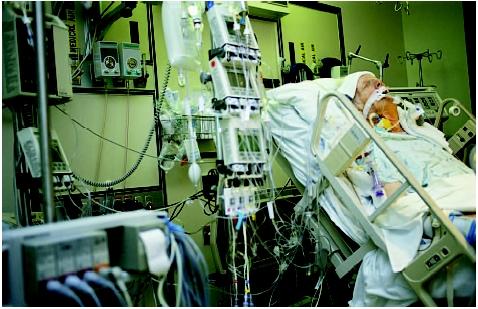
Heart rate, pulmonary capillary wedge pressure, MAP, fluid balance, CVP, inotropic support, balloon pump settings, sats, lactate, base excess, ejection fraction and so on. I got a buzz out of being able to know what was happening with the patient without even seeing their face.
Suddenly one of those collections of stats was someone I knew. I finally put a face to the figures. More than that, I put a face to the relatives that spend their whole day in the waiting room, desperately hanging on for a glimmer of hope. I became one of them for a time.
When you’re looking after a full HDU, something is always happening. When you’re concentrating on only one patient, nothing seems to happen. Our days consisted of sitting silently in the waiting room, walking around the block, nipping out for cigarettes and if we were very lucky, perhaps a minute with the SpR.
There’s a vast difference between nursing staff. Some are rude, obstructive and lie. They claim the doctors are far too busy to speak to relatives. When I’ve been on call, I’ve positively approved of this attitude. Now on the other side, I realise little is more frustrating. Other nurses are great and really keep relatives in the loop. Likewise, some doctors are jerks. Others are absolutely fantastic.
In a less acute setting it can be even worse. My Mum has also spent some time in hospital recently. In contrast to my friend’s mother, this was a planned admission for a knee replacement. Straightforward, but the potential for complications always exists. And whilst not life-threatening, my Mum suffered badly with wound and chest infections and terrible post-op analgesia.
She had to wait four hours for a doctor to write up pain relief. The nurses would mindlessly repeat “we’ve bleeped him” and when he eventually arrived, he dismissed everything I said, presumably because he thought I was too junior.
This pattern of waiting for the doctor was played out daily, perhaps part of a scheme to free up hospital beds, as after a few days my Mum was desperate to leave.
So much of the modern medical apprenticeship appears twee and pointless. Hoops to be jumped through, like the aforementioned reflective practice essays, or apparent time-wasting like communication skills classes at medical school. I was as vocal as anyone with my criticism of what medicine is becoming. I echoed consultants who bemoaned the demise of ‘the old system’ of being taught the science and picking the rest up by osmosis.
Now I wonder if I should have attended more of those communication skills sessions. When I say “more”, I really mean “at least one”.
Textbooks have taught me what I need to know about managing a GI bleed or a sore knee. What textbook could I turn to when I first told a family their father had died? I have broken this news about half a dozen times this year. I am not happy with how any of them went.
Sure, you live and learn, but I look at some of my colleagues and cannot help feeling that they were just born with a better ability at this sort of thing. I think one can learn to communicate better, I have just never felt it to be a priority. For it is a paradox in life that whilst we are more conscious of our shortcomings than our strengths, we spend less time rectifying our foibles than doing what we’re good at.
Hence this year I have consciously pursued an agenda to improve my practical abilities. I’ve taken out an appendix, intubated, cardioverted, lumbar punctured, put in about ten chest and ascitic drains, four femoral lines, two arterial lines, one temporary pacing wire and aspirated more chests and knees than I care to remember. The one procedure I have been especially keen to master has been the internal jugular central line. I have managed to do six, with supervision, simply by being a pest and keeping my eyes open.

Conversely I have avoided interacting with patients and families for the vast majority of the time. I make excuses to myself that my jobs have all been too busy, but I seem to have made time for all of the above. My development has been uneven.
Last week an acutely unwell woman came in to the MAU. There was talk in the air of a central line being needed. The on-call SpR had not had time overnight. Aha! My opportunity. Number seven here we come. “I’ll get everything ready” I said as I practically forced the team into accepting me as the man for the job.
The woman began to deteriorate. I was already preparing to insert the line when her breathing became erratic. “Rohin, don’t worry, you go ahead but we need to get this line in quite quickly,” said one of the registrars present. I looked down and saw quite a young woman. I saw my friend’s Mum. I saw my Mum.
In an acute and unpredictable setting like this, would my running a catheter by this woman’s lung and into her right atrium really be the best we can offer her? I desperately wanted to get another central line under my belt, but I stepped back. “I think you should do this one,” I said to the reg, “I’ll watch you this time.”
Perhaps I am learning something.
Labels: junior doctors, medicine, Rohinplasty articles
Originally published in the May issue of Medical Student Newspaper.
ARE you a bit muddled with this whole MTAS business? Do you nod along politely when people talk about ‘all those poor junior doctors’? Do you secretly not have a clue about medical training? Are you Patricia Hewitt?
MTAS is no more. People are happy. You should know why.
The history
After a few decades, the Indian doctors opened a whisky distillery in Sheffield and the Brits retired to Eastbourne. And so it came to pass that new doctors began applying for jobs.
They used an ingenious system the Romans used to call a 'resumé'. For many hundreds of years this system was used to select junior doctors. But sadly it all came to an attractive end with the famous case of Professor Fry's colorectal firm which consisted exclusively of nubile Swedish female SHOs and one androgynous Thai boy.
Some f*cking genius suggested current selection criteria is outmoded and unfair and the seeds of MMC were planted. That genius had good intentions, but I'd sure like to punch him in the mouth.
A new way of choosing doctors
They say the man responsible for the form designed it with only one hand, as the other is chained to a pipe in his mother's cellar. They say he owns an extensive collection of mermaid porn and rubs soup into his face for hours on end.
MDAP was born, but was so hypoxic at birth it had to be transferred to NICU. An inexperienced F2 had a stab at intubating MDAP but tore straight through its pharynx causing it to die horribly and in great pain.
From its twisted and mutilated neonatal corpse rose the spectre of MTAS. MTAS was a healthier baby than MDAP and made it to school, where it had no friends. This year MTAS put thousands of SHOs in a big pot and shook them around a bit. A few thousand fell out and they went in the jobless pile.
MTAS took a look at the other doctors in the pot and chose a few budbud, whop, spik and bongo names to chuck out, even though they were all Brits. Then MTAS got bored and emailed credit card numbers, pant sizes and sexual preferences of junior doctors to crack dealers, the Klan and C.H.U.D.S.
A Big Medical Association a lot of us pay to represent us didn't do anything to begin with. They were playing MarioKart 64 and kept hitting the lightning before the jump.
A group of sewer-dwelling radioactive amphibians called ReptileUK tried to murder the MTAS staff and the Department of Health with sharpened baguettes.
Some splinter members broke off and realised the key to success was a Facebook group and a flash mob in London. RemedyUK got an unwashed mass of junior doctors together with the promise of blood doughnuts. They protested. Then the Big Medical Association weighed in with immaculate - and by that I mean woefully late - timing.
Patricia Hewitt, meanwhile, dropped her purse into the toilet and lost her library card. She went to the library and asked for a new card. For some reason she explained to the librarian she needed a new card because she dropped her old one in the toilet. As she left, she silently thought to herself "why did I tell her?"
In the deep West Midlands, the ST interview panel walked out. Patricia Hewitt said MTAS was a rousing success. New Zealand, Canada and Australia opened special British doctor immigration lanes at international airports to cope with the exodus from the UK. Patricia Hewitt said any minister that makes an error should resign. She kept on workin’.
Senior deanery staff walked out. Patricia Hewitt said pulling out of MTAS "was simply not a credible option since it would be impossible to place the best candidates in posts and fulfil the service needs in time for August using the old system."
Yet with a mighty slash from Occam's razor, MTAS was culled and lived no more. One day before court proceedings into the fairness of the system began.
A newer way of choosing doctors - the future
It does seem apparent that an elaborate new system of assessments will form the basis of selection for ST posts from next year. Obviously many of the skills required will remain the same.
For example, the requirements for a surgical ST1 job will still revolve around the basic tenets of managing the acutely unwell surgical patient, operative experience, watermelon seed spitting and Turkmeni dancing. Interviews will be replaced by three-stage contests between rival candidates.
The first round will consist of a barefoot jump-rope endurance challenge, with ropes made of glass and a floor made of knives. The second round is obviously ostrich wrestling, now a core part of most medical school curricula. However all trash talk must be in a broad Irish brogue.
Lastly, potential specialist trainee doctors will be selected according to their performance in the petrol gargling clinical governance contest. Only four things will be required prior to short-listing candidates.
They will want a plaster cast of your ear, your thigh circumference, a portfolio of every venflon you've ever inserted (specifying the colour and volume of saline used for flush) and finally fourteen DOPS, twenty two mini-CEXs and eighty five thousand CbDs.
Joking aside, thousands of British junior doctors took up jobs in new continents, far from family and friends. Of those that remained in the UK, about 33,000 have been waiting to hear if they have one of 22,000 jobs or if they will fill a void by working in a short, stop-gap, non-training post. Worse still, they will be reported to the GMC if they choose to leave if offered a better post.
The £250,000 it cost the taxpayer to train each one of them and the streams of cash being poured in to try and rectify the situation are apparently collateral damage.
One can only hope that your year avoids the genuine heartache MTAS has caused. But spare a thought for those a few years above you, life’s been unfair.
Labels: junior doctors, medicine, MMC, MTAS, Rohinplasty articles



Diversity Writer of the Year

Runner-up Columnist of the Year
Nominated Features Writer of the Year






It's the Pirates
Yam Boy
Video Wallah
Shiva Soundsystem
Within / Without

Saheli Datta
Random Acts of Reality
NHS Blog Doc
The Oracle

Turbanhead
HERStory
Ethno Techno

2. Rohinplasty (series)
3. Medical student teaching (series)
4. What your stetho says about you
5. Revision: IT BRINGS DEATH
6. Things you kids won't see (series)
7. Tsunami Politics
8. Churchill: Let the fakir die
9. If it looks like a quack...
10. Ten million missing girls


Real Doctor
They hate you
Incendiary views
Scrooge McDoc
Suspicious behaviour
The Renal Angle
The bastard son of MTAS
All Hallow's A&E
Quack




August 2005
September 2005
October 2005
November 2005
December 2005
January 2006
February 2006
March 2006
April 2006
May 2006
June 2006
November 2006
December 2006
February 2007
May 2007
June 2007
July 2007
August 2007
October 2007
November 2007
February 2008
March 2008
April 2008
May 2008
July 2008
December 2008
-->