Originally published in the June issue of Medical Student Newspaper.
THE very first plasty I wrote after graduating was entitled 'Pretend Doctor'. So it seems rather fitting that my last column as a foundation doctor (the first two years of training) carries the title of 'Real Doctor'. It has taken me two years before I felt ready to describe myself this way, but after last weekend I realised my two F-years have taught me more than I realised.
Some months I have to struggle to find something to write about. Other months it is immediately apparent. I didn't even have to think about the subject matter for my final column as I recently experienced one of the most memorable few days I suspect I will ever work through.
I am currently working in ITU and thoroughly enjoying it. I have been looking forward to this job all year and am considering it as a career choice, but it has only recently dawned on me how ITU is as much about death as it is about saving lives.
During my last weekend on-call, our unit had five deaths within about sixteen hours. None were unexpected, but all were quietly heartbreaking. Two stood out and taught me skills I know I'll find useful throughout my career. The first case was that of a 27 year-old man I shall call Stephen. Stephen had been in the unit for the best part of three weeks. He was admitted with a severe pneumococcal pneumonia on the background of pulmonary sarcoid. Over the days he had developed horrific ARDS with multiple broncho-pleural fistulae and bilateral pneumothoraces.
He was critically unwell for the majority of his stay, dramatically hypoxaemic and hypercapnic, before entering multi-organ failure. By the weekend I was on-call, he had four large-bore chest drains in his chest and quite astonishing surgical emphysema all over his body, puffing his face up like a beachball.
Stephen also had an amazing family. His siblings and parents took shifts to keep him company (only two visitors are allowed at a time) and made sure his favourite records were always spinning in his room. He had an enviable soul music collection, with Marvin Gaye, Stevie Wonder, Smokey Robinson and Billie Holliday constantly vying for attention with the sound of Stephen's high-frequency oscillatory ventilator.
His family were understanding, grateful, calm, realistic, loving and clearly brought closer together by the slow deterioration of their son and brother.
On Saturday chest drains numbers five and six were inserted to attempt to further re-inflate his lungs. He now had three drains in each hemithorax. All six were on suction and bubbling furiously away.
About half an hour before I finished my shift, Stephen's nurse called me in a panic. One of the new drains had stopped bubbling after draining some blood. I realised the tube had a big clot in it and tried to unblock it. This proved somewhat tricky as the clot extended along the entire length of the tube. As I asked for a bladder syringe Stephen's blood pressure started dropping. His systolic fell from 90 to 60 in less than a minute.
Marvin Gaye provided the backing music.
With metaraminol in one hand and the bladder syringe in the other, I nervously kept his BP propped up. I thought this is probably the kind of thing my SpR should know about, but she was speaking to another patient's family. They were in tears, asking her to pull the plug on their loved one, yet she had to rush out midway.
Before she arrived Stephen went into PEA arrest and I started chest compressions. A cycle or two into CPR, Stephen still had no output. I was sure the chest drain was the problem but unblocking it was not easy. Suddenly an idea hit me, one that was both a product of following simple guidelines and attempting to diagnose the problem.
It was Stephen's 28th birthday. Meanwhile, Al Green was singing.

I pulled an orange cannula out of the crash trolley and plunged it deep into Stephen's left chest. A whoosh of air was followed by a recordable blood pressure and a pulse. I'd done it. A tension pneumothorax is such a film and TV cliché but for obvious reasons, it's as dramatic as hell.
I wanted to be the one to talk to Stephen's family. I am not sure why, was it anticipating the kudos I would receive after telling them of my actions? Or was it simply because I had developed a relationship with them and wanted to be involved? They were, as always, quite remarkable. They seemed genuinely concerned with thanking Stephen's nurse and me. Whatever bravado I had felt melted away as I realised that despite my proud moment, Stephen was in the same position he was in half an hour before.
By the time Stephen died, aged twenty eight and one day, within a day of this tumultuous episode, he had seven drains in his chest. A final blow was dealt when the transplant team, requested by his family, opened Stephen to find not a single viable organ.
Another death at the weekend was that of an old friend, a 70 year-old I will name John. I say old friend because I had known John for eight months. I met him in A&E and got to know him and his family during my four renal months, during which he was an inpatient for the entire duration. John had a past medical history as long as your arm and what I thought was the family from hell.
The entire renal team was wary of them. They were abusive, demanding, unfair and sometimes malicious. In fact I wrote about them once before because they drove me up the wall. John paid me a visit in ITU; his fourth admission there.
I warned colleagues: "be careful with that family" but soon realised that it was the renal ward they had trouble with, not any individuals, as they were perfectly friendly to me in ITU and indeed sought me out as someone to talk to as I was a familiar face. John became very sick very fast and suddenly I found myself in the breaking bad news mindset. Once again I took close family into the 'relatives' room' to suggest he had only hours remaining.
From the first time I met John he was bed-bound and withdrawn, but I learnt he was once a proud patriarch of a huge extended family. His two daughters and his wife remained by his side as the months had gone by and whilst I would once have ducked into the doctors' office to avoid a confrontation, now I saw three women losing the man of their house. I was overcome with guilt. I should never have let myself dislike these people.
John's wife, who had become quite motherly to me over the weeks and months, surprised me. She leapt up to hug me and said "I'm so glad it was you." I can assure you I wouldn't be glad if I was my doctor but I think one recognisable face in the bustle of ITU was reassuring.
Later I was with another patient and my SpR came over in floods of tears.
"What's wrong?"
"It's John, his whole family's there and it's just so sad. They're asking for you."
I nervously parted the curtains around his bed and found about twenty people crying, holding hands, saying prayers. It was clear that John commanded utter respect from those around him. It would have been nice to know him as his former self.
His wife brought me right into the middle of the throng and I felt like a complete imposter. Did they know how I used to feel about them? She told me that I always treated John like more than just a patient, that she would be sad she wouldn't see me again and that I will always be in her prayers.
I definitely did not deserve this. The feeling of guilt at receiving praise I was unworthy of, combined with the real happiness that I had made something of a connection with this family was unusual. I am sure I won't forget what John's wife said to me, perhaps even more so because of our colourful previous dynamic.
Corny or not, I can honestly say I will remember this weekend as a seminal point in my career. The moment I realised I am a doctor that can save a life - albeit only postponing death for a day - and that can make an emotional connection with a patient's family.
In the nicest possible sense, I hope you all experience an occasion in your career where you are forced to exceed what you thought were your limitations. When I finally got a day off several days later, I was exhausted and drained, but I had never felt more positive about my job. These are the experiences that teach you more than any DOP or CbD ever could.
After four fantastic years editing and writing Medical Student Newspaper, I can finally switch my bleep off. Good luck.
Labels: death, junior doctors, Rohinplasty articles

I WAS on the wireless today. It's not the first time - I was on Anita Rani's show on the BBC Asian Network talking all about porn, but that's another story. Today I made it, interviewed by Eddie Mair on iPM. Like most people, I despise hearing my voice, but it could have been worse. I was asked to comment as a piece I wrote for the paper about a year and a half ago was picked up. The topic under discussion was ash cash.
No sooner than one British establishment featured the DR, another did. Now I've really made it. The great Dr Crippen talked about ash cash too, which is why I thought I'd write this quick note.
The passage quoted on Dr Crippen's and iPM's blogs is tongue-in-cheek and I take any accusation of being insensitive on the chin, for it is deserved. But the passage should be taken in context, so do please read the rest.
Dr Crippen does indeed make the exact same point I did in the extended interview, hospital doctors who deal with death on a daily basis utilise coping strategies that are insensitive. When we talk about getting your ash cash from the ash point, or make jokes about celestial transfers to the big ward in the sky, it is merely a way of distancing ourselves from the fact someone has snuffed it. Crippo's right, we don't develop the same relationships with our patients that a GP might (well, polyclinics will see an end to that).
"I wish I was young again so that it could all be fun and “ash cash”, but I am no longer young. My skin is no longer Rhino-thick for now I understand what I am doing, and how important it is that I do it properly." [Link]
I enjoyed reading some time back that the venerable NHS Blog Doc describes himself as a curmudgeonly git, as this is how most of my friends would refer to me. Whilst I have maturing to do before I reach Crippenesque gravitas, it does not mean that youth eschews pathos.
Sure we joke and pick up our ash cash cheques, but I think we all spend a quiet moment contemplating the elapsed life we are signing off into the flames. In its great early days, Scrubs occasionally featured some great lines. JD looks at his first dead patient and says "he looked exactly the same, only completely different."
Moments like this, and fumbling awkwardly for a pacemaker across a cold corpse, are the experiences that stay with you and shape your development in medicine. But they're put away and covered by tasteless jokes at the pub. Just the way, I feel, it should be.
Labels: death, junior doctors
Originally published in the April issue of Medical Student Newspaper.
YET another horrible, horrible month rolls around and curse you Satan, curse you, I'm still alive.
Something's gone terribly awry as I am working a nightshift in A&E...when I don't have to. Yes I have voluntarily taken a locum shift in the hellhole that spat me out four months ago.
In fact this is just one in a line of locum shifts I am making a tradition. One nurse takes great pleasure in teasing me, "ooh look who's back, he who said he would never step foot in here again! You love it really."
How wrong she is. The question is then begged: why am I here? I don't seek to answer this in quite the metaphysical way Aristotle intended, but why am I seeing a perianal abscess at 1am? The only reason people do anything, money.
Once upon a time I used to pride myself on being quite an enlightened soul. Sure sure, this sounds funny NOW but only because you know me as the shallow git I undoubtedly am. However money never used to be high on my life's agenda.
I suppose any doctor would say the same - we're all in the wrong profession if money was our primary concern. But I really was other-worldly in my disinterest with money. I was generous and thought I would work for free as long as I had a roof over my head.
What complete gash. Over the last few months I have become the guy Scrooge McDuck aspired to be, well except for the swimming in your own money thing. That ducker still trumps me there.
I seem to spend my every waking minute thinking about money, whistling Pink Floyd's Money and carrying the FT. Just carrying it, I can’t read it. Now the reason I have subjected myself to additional A&E (along with some medical SHO) locums become clearer. I want money.
I think I can pinpoint where my slide from Buddha-like nirvana to cash-hungry Scotsman happened, and like just about everything in my life, it revolves around jobs.
It was only when I actually got a job that the immense stress on my shoulders became apparent. For months I had deluded myself that I was a chilled out cat, unaffected by job applications and an insecure future. In reality I never realised how much I was suffering.
I'm not alone. Perhaps 50% of my friends are still without employment come August. Feeling insecure about the future is a horrible thing and it had engendered a passion for money I had never experienced before.
With money, I felt I would be able to absorb the blows dealt to me by unemployment, I thought my Benjamins would help me roll with the punches. I spoke to senior colleagues about how much cash I would have to sleep on when I got to their level.
Horror. It turns out I'm earning more than my registrar. Sweet Jesus, several more years of hard graft and my pay will go DOWN.
Not only were my hopes of having a money-mattress dashed, I realised I wouldn't even have enough notes to light cigars with. 'Twas at this point I resolved to turn my efforts towards lining my pockets with the green.
Hence why you find me here, volunteering my time in the place I hate for the sum of £30 an hour. Sounds quite tasty, right? Certainly more than an SHO could expect to make in a permanent post. What if I just worked locum shifts? I calculate I could have an annual salary of £72,000. Not actually that impressive when I consider my best mate, who was at uni half as long as me, is on the same figure plus bonus and his company are buying him an Audi R8. I still drive my Nissan Micra.
As it happens, I know someone that decided to do exactly this, be a lifelong locum. He now owns five properties. The crucial difference is he is a GP. An agency I am registered with lists the following pay rates for hospital doctors: F1 - £21/hour, SHO £30/hour, SpR £34/hour and consultant £46/hour. The rates are the same irrespective of time or day.
For general practitioners, who will now be fully qualified five years out of medical school have slightly different rates: Mon to Fri - £100/hour, weekend - £125/hour and bank holiday - £200/hour.
The positives, let's concentrate on the positives. 20% discount at Nando’s. Back of the net.
Despite my enjoyment at reaping the rewards of locum shifts, they do represent a short-sighted waste of money by the NHS. A recent BMA survey shows that 30% of junior doctors are working on teams with at least one vacancy. My team has three. Hospitals spend money on expensive locums to cover shifts, but most of the time hapless SHOs and SpRs are strong-armed into ‘working a few extra hours’.
These vacant posts, all the more risible when thousands of SHOs are unemployed, are a legacy of MTAS and this year’s unnamed successor.
Consider two systems, both flawed. Years ago the SHO slaved away for three hundred hours a week, slept once a fortnight, knew all the patients and learnt bucketloads. Now I work a shift system, have an astonishing four handovers a day and there is practically no continuity of care for patients. Surely there is a middle ground?
As juniors’ training hours are slashed by the European Working Time Directive, and the time it takes to become a consultant is reduced by the government, we move towards a scenario where tomorrow’s consultants have perhaps a quarter the experience of present-day consultants. Likewise, practical skills suffer.
A renal job should mean getting to do loads of central lines. Sure…provided there is no team of specialist nurses inserting all the lines. They’re good at what they do, they’re cheaper than an SHO and don’t move on every four months, so why would a trust want a doctor doing these procedures? This way the number of expensive and troublesome doctors can be cut.
A superb plan. Except for the fact that I severely doubt the venous access specialist nurses will be around at 2am when a patient has crashing septic shock and needs a central line. But I will.
Labels: A+E, junior doctors, Rohinplasty articles
Originally published in the March issue of Medical Student Newspaper.
I'M desperately trying to avoid writing about the rhino sitting on the elephant riding a unicycle in the room, again.
You’re bored of my ramblings about jobs, applications, unemployment and emigration. OK you’re bored of more than that. You’re bored of my tangential offal, lazy similes, dull subject matter and self-endulgent banter. But you’re still reading so haha up yours in your face pwned roflcopter lollerskates lmaonade lollercaust lollergeddon!!!!11!!!one
Hence I will endeavour to side-step my impending joblessness by telling you about the joys of renal medicine. Stop laughing.
I started this job having been a doctor for sixteen months and the step-up in responsibility was immense. I cover all renal, access surgery, dialysis and transplant patients and much of the time there is no registrar on-call with me. Just me and one of the country’s biggest renal units. Uh oh.
Getting used to dealing with critically unwell patients is part of being a hospital doctor and after my A&E resus experience I am feeling more confident. However an unexpected duty has been the referrals and calls for advice I have received from several other hospitals and local GPs.
At first I was apologetic and bumbling when GPs asked basic questions but as my ego grew in stature, I became more confident. Patients may still refer to me as ‘the one who doesn’t look old enough to be a doctor’ but on the other end of the phone my tenor tones could be anyone.
Recently I took a call from a teaching hospital, where an A&E SHO had seen a dialysis patient and wanted to arrange a transfer as he was ‘due dialysis’. It transpired he was septic and far too unstable to transfer, so I was surprised this doctor hadn’t sent him to ITU. Secondly, when I asked if he needed to be dialysed, she had no idea how one would decide this.
I walked her through the basics of fluid assessment and electrolyte control, much as I do with third year medical students. It was only when she gave me her name at the end did we both realise she had been an SHO at my previous hospital, several years above me and signing my DOPS.
Roles do often reverse when rotating around medical specialties. From the A&E grunt making the referrals, I am now taking them. I fight my natural tendencies and try not to be an arse, as I know how unpleasant referring to a dickhead is.
I don’t mind being called by house officers - I remember what it was like and I remember not needing to study much nephrology to pass finals. So I try to emulate the specialists I’ve enjoyed talking to and take time to explain renal physiology or the concepts of dialysis.
However when a surgeon calls, I have a little fun. Like the cardiothoracic consultant who asked his SHO to call me due to a rising creatinine. I suggested perhaps the new prescription of trimethoprim and the gentamicin level of 29 (aim <10)>
“Is the renal function normal?”
“Yes.”
“So it sounds like a urology problem, not a renal one.”
“But it’s renal colic.”
“No, it’s urology colic.”
A big poster at work tells me to ‘Save a Life, Give Blood’. Right on. Clearly some people think this is a cop-out. In light of the recent kidney-harvesting ring rumbled in India, I discovered a phenomenon I had never previously known about.
Donating a kidney is amazing. Doing this for a loved one is understandable, but I was immensely impressed when I first met a guy who was giving a childhood friend his right kidney. Yet nothing prepared me for the ‘altruistic donor’.
This is normally a man (in my experience) who wakes up one day and thinks “you know, I have too many kidneys”. He decides to undergo general anaesthesia and have half his piss-making equipment chopped out - for someone he will never meet. It’s quite astonishing - even a curmudgeonly git like me can be impressed by truly generous people, however loonie I think they are.
Labels: junior doctors, Rohinplasty articles
Originally published in the February issue of Medical Student Newspaper.
GOOD morning my friend! A warm good morning to you all. I love you, faithful readers, I love you with all my heart. But sadly I wish to commit heinous murder upon you at this present juncture in time, and indeed upon anyone that gits in mah way cos I is mad.
What, you might ask, has made such a normally cheery (I can be cheery) soul like me so irate? Did that A&E job finally make me crack? On the contrary, I finished it since I last saw you and have moved onto renal and transplant medicine. Wonderful wonderful.
Was it a bothersome patient what yanked my crank? No, I have been tolerating humans quite well recently. Is it the fact that my girlfriend’s Mum is staying with her for a month? Yes you’re quite astute, that’s probably not helping BUT it ain’t the root cause.
You’ve guessed it – job applications. I have brought you MMC news from the coalface over these last sixteen months, but at no point have I ever felt so low. Sure I’ll be cracking jokes in this piece, but secretly (and by writing this here, not secretly) I want to end my life. And I haven’t forgotten about murdering you either.
So what’s the dilly-yo? In a nutshell, for those shitbricks that haven’t been paying attention for twelve months, in 2007 the government unleashed its full wrath upon those lazy doctors and made tens of thousands jobless. 28,000 doctors applied for 15,500 jobs.
They did this by installing a woeful new application system, reducing the number of training posts despite record numbers of new graduates and not accounting for the many overseas doctors that work here but inviting a lot more in.
Thousands of junior doctors, many of whom are my friends, left the country. No one outside the rank of SHO seems that annoyed, so please do tell non-medics why they should be. Each of these doctors cost a quarter of a million pounds of taxpayers’ money to train. We, as a nation, have just let hundreds of millions walk out of the door. Australia, New Zealand and Canada’s gain is our huge loss.
I never thought I was the ‘leaving kind’. I love London and want to stay. That could be my downfall.
This year, it is worse. We were reassured but I think we all knew this to be false. However, last year we were provided with some ammunition. The Tooke Report, detailed in previous issues of this newspaper, made two key assertions. First, that government involvement with the training of junior doctors must stop. This has not transpired. Secondly, that the European Working Time Directive (which I recall being my first cover story as editor in 2004) is detrimental to junior doctors’ training by preventing sufficient hours learning on the job.
Reasons things will be worse this year include: many of the jobless SHOs from last year will be competing with this year’s glut for the same finite amount of jobs (in fact less, as much of the run-through allocation is filled). A recent ruling means that British-trained doctors are given no preference to overseas doctors when allocating jobs.
Overall, an estimated 22,000 applicants will compete for 9,000 jobs. Friends in other professional disciplines often seem confused as to why this is a problem. “Competition is healthy” they say, echoing what the government has been trying to dupe patients with. The key point is that in the UK, doctors can only train in the NHS, there is no alternative as there would be in a bank or law firm.
Continuing on from this analogy, consider my story, which I fear will be typical.
Today I received an email from Oxford Deanery, telling me I have been invited for interview in six days. I have heard, from an unsubstantiated source, that about five hundred applications for Core Medical Training were received by Oxford. They have 27 jobs to give away. So I am delighted I have been granted an interview.
But I have applied to both London and Kent, Surrey and Sussex because I, like a vast swathe of my colleagues, have been scared shitless by what happened last year. I have tried not to hedge my bets and end up jobless.
Let’s imagine I do well in the interview (you need a fertile imagination) and am offered a post. At this point I know none of the following: which hospital(s) I will be working in, my pay, my rota nor what firms I will be doing. Yet I have 48 hours and nor more to accept. If I don’t reply, I am assumed to have rejected the offer.
If I accept, I have to withdraw from all other Deaneries. The only problem is, London make their offers two and a half months after Oxford. So if I decide I want to wait it our for London – and then get offered nothing, I will have thrown away a job. Or if I hold out for London and get given a job I don’t want, I would rather have stayed with Oxford.
Taking our comparison back to banking or law, which companies do you know that would make a job offer with no details about the job whatsoever? Which industries can you think of where the boss doesn’t choose his own staff? And although some jobs make you move around the country, which gives a few weeks’ notice as to location, forcing the employee to sell, buy and move houses in a month?
Lastly, see if you know any banks or consultancies that would send this message to its employees. My ultimate boss, the government, sent all junior doctors a letter in January. It essentially said “don’t apply for anything competitive, you probably won’t get it. Don’t turn down any job applications, you will be lucky to even get one. Don’t be upset if you end up doing something you didn’t apply for, you should be thankful you’re employed.”
It amounted to: Aim Low. No fucking way any City firm says that to its employees. We’re being grown as a generation of ‘just passable’ docs. MMC engenders a culture of striving for mediocrity.
As I said before, I love London with all my heart. I want to make my life here. But in the last few weeks I have done some deep thinking. I had a hot bath recently – where I do my best thinking – and asked myself one question, “do I want to be a doctor?” I had toyed with the idea of leaving. Friends enquired at banks and they want to start me on £80-100,000p.a. But I realised I like being a doctor. It’s what I’m best at and I want to do it. This was a relief as I had started to have doubts.
The second question I asked myself was, “do I want to be a doctor in the UK?” I now know that without drastic change of far more than just the subject of this article – nurse quacktitioners, paltry consultant opportunities and the media’s attitude to us – I cannot stay here. The system has broken me.
Labels: junior doctors, MTAS, NHS, Rohinplasty articles
Originally published in the November issue of Medical Student Newspaper.

IT’S HALLOWE’EN in A&E. I start my shift at
Two out of six. As I can’t really take any credit for being male, I better try to enjoy my last month ‘working in emergency medicine’, which won’t be easy.
My first patient is what we politely refer to as a complete loon. I’ll call her Agnes and she’s visiting us from the local psychiatric hospital. Agnes has been sectioned for some time (don’t ask me what number) and hates the psychiatric ward she is on. It quickly becomes clear she is fabricating a story to get out of her ward. The psychiatrist must have seen her, realised he knows nothing about medicine and sent her to A&E.
It is, however, a little difficult to understand her as she has two Nicorette inhalers in her mouth. Not to mention the five Nicorette patches on her abdomen, her brown sunglasses, orange hair, five overcoats and two scarves.
Her sense of humour seems to be intact though:
“Doc, I’m telling you now, if you send me back there I will kill myself.”
“Well that’s convenient,” I replied, “because when people want to kill themselves we send them to psychiatric hospital.”
“In that case I don’t want to kill myself, I want to live!”
I’m rather in the mood for seeing some ghouls and ghosties tonight, and head to Minors in the hope of stitching up a pitchfork-laceration or vampire bite. I’m collared on the way by sister saying two are waiting in Resus.
I generally like working in Resus. You see, the overriding gripe I have about A&E is time-wasters. I have to resist slapping jackasses with nothing better to do with their time than ignore the sign saying “Accident and Emergency” and waltz in with problems they’ve had for years. But Resus patients (normally) aren’t faking it.
We’re short-staffed and I end up seeing two patients simultaneously. This is not only dangerous, it’s confusing. Luckily (for me, not them) they had almost identical problems (chest infections and fast AF) and pretty similar names, so I just said everything twice.
There’s no chance of me getting to Minors to see any pumpkin-heads after I’m finished with the two old boys in Resus, as “people are breaching in Majors.” Nurses always shout this at me under the impression I’m going to care.
A guy who felt his throat was closed for a minute, but is fine now. A girl who had chest pain but thinks it was wind. Then a bad-tempered Francophone jobseeker who broke his foot and was put in a cast two days ago, has a fracture clinic appointment in the morning and saw his GP two hours before coming to A&E. I explained broken feet do normally hurt, but he wasn’t satisfied.
In fact he turned out to be a real prick and I had to threaten to call security, in French, before he left. Not before shouting in Franglais:
“Where you from? How old you? You’re too yang bro! Je veut un autre médecin. Na, na, you got a long way to go.”
Whilst he was undeniably a tosser, he was probably right.
Where are those damn vampires? A frikking zombie at least, please Satan brighten my evening with something macabre.
The three others doctors on duty and myself wade through nursing home specials, neurotic parents, drunkards, asthmatics and more chest and abdo pains than you can shake a steth at.
2+ protein, 1+ blood, 1+ ketones. Ketones? I wonder what my blood glucose is? 2.9! Sweet, a new record. I mean, I think I’m going to faint. I rush dinner having wasted half my break investigating myself.
Back on the shop floor and I pick up the next card. “Limb problems” is the non-specific triage category and at last it’s a bunch of piss-artists in fancy dress. w00t!
My patient is not only dressed as an axe-wielding blood-soaked doctor, she’s an absolute hottie (I only mean that in a purely Hippocratical way).
Good-natured drunks are always fun so I act the part. Whilst taking a history I point to her friend in vampire garb and ask, “he with you?” and then examine her neck.
"What are you doing?" asks the friend.
"I need to know if she’s turned."
So she clearly has a thing for doctors and I will be spending the next half hour with her in a small room sewing up her elbow. I silently offer thanks to the Prince of Darkness as my mind turns back to that Lancet article.
However as she’s face-down for the stitching, I (tragically) spend most of the time talking to her friend, who wants to become a doctor. I give him half-mumbled answers as I get so engrossed in trying a fancy mattress-running suture combination on this hapless girl’s elbow.
When I’m done she bounds off without so much as a “thank you doctor, you saved my life” and an unexpected kiss on the lips, or a “how can I ever repay you?” and a lingering kiss on the cheek or even a “call me!” and an airkiss. In fact there was a distinct lack of kissing.
Somewhat confused as to how I could POSSIBLY have been turned down, I remembered I was lacking in brilliance, height, muscles and chiselled features. Soon I would lose my job title of emergency doctor as well. I mulled it over and decided I would rather undergo extensive leg-lengthening surgery than take another A&E job.
I finally allowed the chatter of friend-who-wants-to-be-doctor through and in an unusual display of paternalism, I put a hand on his shoulder and said “son, don’t do it.”
My shift would be up soon and I could grab a Rosie Lee’s Full English on my way home. Working nights eliminates your ability to do anything, so I’ll get back to working on my serum and saving the world from vampires next week. Right now, I’m just the daysleeper.
Labels: A+E, junior doctors, medical students, Rohinplasty articles
THE geniuses behind Medical Student Newspaper have produced some essential reading for all final year medics in the UK, in conjunction with doctors.net.uk. Quack contains all the knowledge one needs to apply for a Foundation post and more. Join the Facebook group.
My contributions included updated versions of stethoscope psychology, depraved revision, a breakdown of the MTAS saga and the WISE words below.
By the way, Medical Student Newspaper has won yet another award nomination. It is in the running for the Best Student Newspaper in the country at this year's Guardian Student Media Awards. Every year since the paper's inception has brought some silverware; fingers crossed.
How to be the coolest, most pimped-out, badass FY1 at your hospital
What you need to know as a first year doc and what you haven’t been told
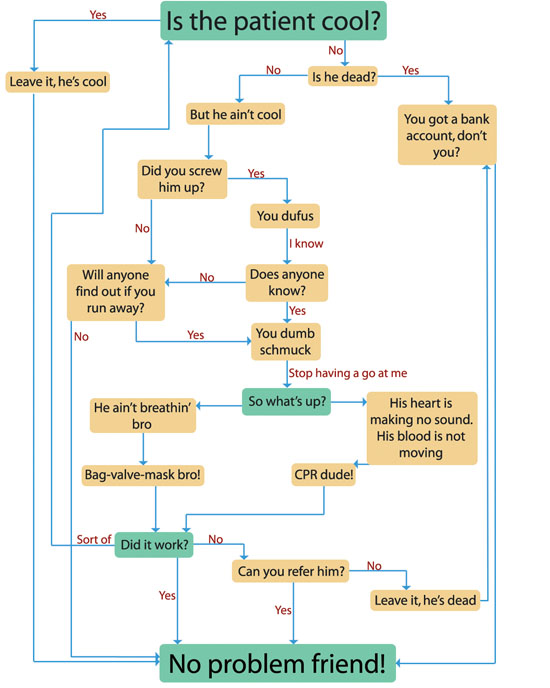
The most up-to-date Advanced Life Support (ALS) algorithm. Use this at any stage during your Foundation Years; acutely unwell patients will be a common encounter and you should feel confident in determining whether a patient is cool or whether they need your help. If unsure, feel free to ask “are you cool?” Don’t be afraid to tell your patients to BE COOL.
There is no one way to be a good FY1, or house officer, as you will still find yourself referred to. However there are certain hints and tips that can be imparted by those that made it through. Intact. Unscathed. Ready to fight another day. ONWARD!
First and foremost, your first year as a doctor should be about enjoying yourself. Never forget this. There are many similarities to life at medical school; you will probably live in halls, go out too much and make lots of new friends. The only real differences are that you can’t bunk off anymore, but you do get paid.
The single greatest fear of a new doctor is that they will do some harm to a patient. This, whilst not impossible, is improbable. The reason being that you have spent four to six years learning how to do the opposite.
You are so imbued with misplaced self-doubt when you start working that you end up being over cautious. This is normal. Don’t worry about making mistakes, just concentrate on enjoying yourself and the rest will flow.
Perhaps the one gem of information I wish I had been given before I started was that you did not need to be top of the class at medical school to succeed in your first year of work.
In fact, where you ranked has no correlation whatsoever to how you will perform and you should put it out of your mind entirely.
If the comparison of FY1 to medical school can be extended, then the first week is Freshers’. With most junior medical staff now starting at the beginning of August every year, the hospital will be atwitter with introductions and nice-to-meet-yous when you start.
The first few days are rarely taxing. They normally consist of induction talks, orientation sessions and a gradual easing into the job.
You might turn out to be one of the unlucky punters that kicks off work with an on-call. Daunting it may be, but on-calls are fantastic learning opportunities. Asking for help is something you should never be afraid of doing in your first year. People will fully expect you to ask the most inane of questions, even if you feel like an idiot. Get over that embarrassment and ask – better that than goofing up something easy.
There is also no shortage of people to ask. Obviously your immediate seniors are a logical first step, but the resource you will invariably draw upon throughout your junior years is the nursing staff. If you take one piece of advice away from this article, make it this: be nice to nurses.
Nurses can make your life so much easier if you acknowledge their existence and value their contribution, and they can equally give you grief if you piss them off.
Nurses, like anyone else, don’t like being talked down to by snooty doctors. If you’re not sure what fluids to write up, or what the dose of metoclopramide is, asking a nurse is a good first move.
Having said that, nurses go through a learning process too and might be just as green as you. If you’re unsure about any advice given, there’s no harm getting a second opinion. You will find that the ability to know what is duff advice and what is good sense develops quickly and naturally.
A further word about those nurses. Most FY1s will be ward-based and whilst it is useful to be nice to nurses on-call, it is imperative to establish good relationships with the nurses on your own ward. They can be inordinately helpful if you’re mates. Not to mention that if you can have a laugh with the nurses, social workers, ward clerks, physios, OTs, HCAs or medical support workers on your ward, your job will all the more fun.
This provides a convenient segue onto what is likely to be the bane of your life during the Foundation Programme. Assessments. You thought tick-boxes and form-filling ended with graduation. I laugh at your foolishness.
Working well with those around you will stand you in very good stead for a key part of your overall assessment, the min-ePAT. Out of all the nonsense you are forced to complete in your first year, this is a very useful exercise.
On two occasions you are required to nominate twelve co-workers, of whom only a limited amount can be doctors, to anonymously say what they think about you. As you can imagine, the ability to be frank allows your colleagues to give you what can frequently turn out to be valuable advice.
All that need be said about the rest of your assessments is that the sooner you get them out of the way, the better. Try not to leave yourself a week to get all the forms filled in, it is no fun.
To reiterate, it is imperative you concentrate on having fun in your first year. It comes only once and just about every doctor you meet looks back on their house officer year with great nostalgia and fondness. No amount of hints and tips from seniors will replace your learning-by-doing, so try not to be wallflower.
If something that interests you is happening, be it inserting a central line or an appendicectomy, try to get involved. Be in the right place at the right time, but don’t be a dick – share out opportunities with friends.
Developing confidence comes far more easily to some than others, but ultimately the only occasion it matters is when a patient’s health is in question. If you are seeing someone in A&E or on the ward and you are unhappy about something, never worry about ‘bothering’ your seniors. Whilst it may be surprising to some, no one will criticise a new doctor for being too safe.
Lastly, if you are one of those keen young things that wants his or her name in lights, your first step would be to leave medicine. However if you want to stay, you might want to consider getting involved with an audit, a presentation or two (most hospitals expect a Grand Round presentation from all the juniors) and if you’re extra ambitious, a publication.
Having said all that, none of these are necessities. The only compulsory objectives for an FY1 are consolidating your medical knowledge (it’s up there somewhere, even if it doesn’t feel like it), seeing patients, getting organised, using your hands, extra-curricular high jinx and wild japes. These are integral to being a good doctor. Good luck and get ready to work like a HO.
Originally published in Quack: Foundation School Guide.
Diagram inspired by ALS guidelines and a flowchart from Antarctica, by Kim Stanley Robinson.
Labels: junior doctors, medicine
MY first year is drawing to a close. The next generation of F1s have graduated, got pissed and are enjoying that golden summer after medschool. Soon I will no longer be the most junior doc on the team and I might even have people asking for my advice. Every time I mess something up (and I will) after the end of July, I won’t be able to simply excuse myself on the grounds I am “just the house officer”.
Part of the exercise in group stupidity that is our MMC assessments is a tedious cataloguing of ‘reflective practice’. We are supposed to document the cock-ups, the near-misses and blips that we have learnt from. Of course I spent half an hour before my sign-off meeting making mine up.
Ironically, writing this column has forced me to reflect on my conduct as a doctor more than any contrived questionnaire could. I spent a little while browsing what I have written for Medical Student Newspaper this year and I realise I have come full circle. The first piece I wrote, in October last year, professed how I need to see things through the eyes of patients’ family members. I didn’t change. Nine months on, tragic events have finally shocked me into an attitude re-evaluation.
One of the many criticisms one could level at me is cockiness. I have been gung-ho on more than one occasion. Whilst I have not endangered patients, I have certainly made more work for myself by charging ahead without due forethought – and more importantly I could have made a patient’s stay less unpleasant.
I write this having just returned from Royal Free’s ITU. My very best mate’s Mum suddenly suffered a massive antero-lateral MI and out-of-hospital VF arrest. He’s a school friend and a lawyer, she’s a healthy woman in her mid-40s with no risk factors apart from family history. Without going into details, she has been making erratic but slow progress over the last two weeks and we are optimistic.
I’ve tried to be as supportive as I could be, but I’ve also done my utmost to explain the immensely complex events to my friend. I hope I helped. However, in a roundabout way, I have helped myself.
I’ve been privileged enough this year to get exposed to a high level of critical care. I’ve managed patients in coronary care and in surgical HDU. Next year I’ll be working in medical HDU and ITU. I love it – standing behind the chart, absorbing the figures.
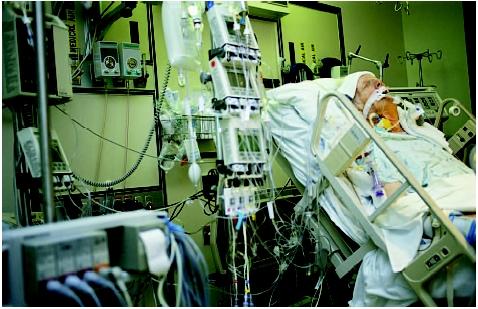
Heart rate, pulmonary capillary wedge pressure, MAP, fluid balance, CVP, inotropic support, balloon pump settings, sats, lactate, base excess, ejection fraction and so on. I got a buzz out of being able to know what was happening with the patient without even seeing their face.
Suddenly one of those collections of stats was someone I knew. I finally put a face to the figures. More than that, I put a face to the relatives that spend their whole day in the waiting room, desperately hanging on for a glimmer of hope. I became one of them for a time.
When you’re looking after a full HDU, something is always happening. When you’re concentrating on only one patient, nothing seems to happen. Our days consisted of sitting silently in the waiting room, walking around the block, nipping out for cigarettes and if we were very lucky, perhaps a minute with the SpR.
There’s a vast difference between nursing staff. Some are rude, obstructive and lie. They claim the doctors are far too busy to speak to relatives. When I’ve been on call, I’ve positively approved of this attitude. Now on the other side, I realise little is more frustrating. Other nurses are great and really keep relatives in the loop. Likewise, some doctors are jerks. Others are absolutely fantastic.
In a less acute setting it can be even worse. My Mum has also spent some time in hospital recently. In contrast to my friend’s mother, this was a planned admission for a knee replacement. Straightforward, but the potential for complications always exists. And whilst not life-threatening, my Mum suffered badly with wound and chest infections and terrible post-op analgesia.
She had to wait four hours for a doctor to write up pain relief. The nurses would mindlessly repeat “we’ve bleeped him” and when he eventually arrived, he dismissed everything I said, presumably because he thought I was too junior.
This pattern of waiting for the doctor was played out daily, perhaps part of a scheme to free up hospital beds, as after a few days my Mum was desperate to leave.
So much of the modern medical apprenticeship appears twee and pointless. Hoops to be jumped through, like the aforementioned reflective practice essays, or apparent time-wasting like communication skills classes at medical school. I was as vocal as anyone with my criticism of what medicine is becoming. I echoed consultants who bemoaned the demise of ‘the old system’ of being taught the science and picking the rest up by osmosis.
Now I wonder if I should have attended more of those communication skills sessions. When I say “more”, I really mean “at least one”.
Textbooks have taught me what I need to know about managing a GI bleed or a sore knee. What textbook could I turn to when I first told a family their father had died? I have broken this news about half a dozen times this year. I am not happy with how any of them went.
Sure, you live and learn, but I look at some of my colleagues and cannot help feeling that they were just born with a better ability at this sort of thing. I think one can learn to communicate better, I have just never felt it to be a priority. For it is a paradox in life that whilst we are more conscious of our shortcomings than our strengths, we spend less time rectifying our foibles than doing what we’re good at.
Hence this year I have consciously pursued an agenda to improve my practical abilities. I’ve taken out an appendix, intubated, cardioverted, lumbar punctured, put in about ten chest and ascitic drains, four femoral lines, two arterial lines, one temporary pacing wire and aspirated more chests and knees than I care to remember. The one procedure I have been especially keen to master has been the internal jugular central line. I have managed to do six, with supervision, simply by being a pest and keeping my eyes open.

Conversely I have avoided interacting with patients and families for the vast majority of the time. I make excuses to myself that my jobs have all been too busy, but I seem to have made time for all of the above. My development has been uneven.
Last week an acutely unwell woman came in to the MAU. There was talk in the air of a central line being needed. The on-call SpR had not had time overnight. Aha! My opportunity. Number seven here we come. “I’ll get everything ready” I said as I practically forced the team into accepting me as the man for the job.
The woman began to deteriorate. I was already preparing to insert the line when her breathing became erratic. “Rohin, don’t worry, you go ahead but we need to get this line in quite quickly,” said one of the registrars present. I looked down and saw quite a young woman. I saw my friend’s Mum. I saw my Mum.
In an acute and unpredictable setting like this, would my running a catheter by this woman’s lung and into her right atrium really be the best we can offer her? I desperately wanted to get another central line under my belt, but I stepped back. “I think you should do this one,” I said to the reg, “I’ll watch you this time.”
Perhaps I am learning something.
Labels: junior doctors, medicine, Rohinplasty articles
Originally published in the May issue of Medical Student Newspaper.
ARE you a bit muddled with this whole MTAS business? Do you nod along politely when people talk about ‘all those poor junior doctors’? Do you secretly not have a clue about medical training? Are you Patricia Hewitt?
MTAS is no more. People are happy. You should know why.
The history
After a few decades, the Indian doctors opened a whisky distillery in Sheffield and the Brits retired to Eastbourne. And so it came to pass that new doctors began applying for jobs.
They used an ingenious system the Romans used to call a 'resumé'. For many hundreds of years this system was used to select junior doctors. But sadly it all came to an attractive end with the famous case of Professor Fry's colorectal firm which consisted exclusively of nubile Swedish female SHOs and one androgynous Thai boy.
Some f*cking genius suggested current selection criteria is outmoded and unfair and the seeds of MMC were planted. That genius had good intentions, but I'd sure like to punch him in the mouth.
A new way of choosing doctors
They say the man responsible for the form designed it with only one hand, as the other is chained to a pipe in his mother's cellar. They say he owns an extensive collection of mermaid porn and rubs soup into his face for hours on end.
MDAP was born, but was so hypoxic at birth it had to be transferred to NICU. An inexperienced F2 had a stab at intubating MDAP but tore straight through its pharynx causing it to die horribly and in great pain.
From its twisted and mutilated neonatal corpse rose the spectre of MTAS. MTAS was a healthier baby than MDAP and made it to school, where it had no friends. This year MTAS put thousands of SHOs in a big pot and shook them around a bit. A few thousand fell out and they went in the jobless pile.
MTAS took a look at the other doctors in the pot and chose a few budbud, whop, spik and bongo names to chuck out, even though they were all Brits. Then MTAS got bored and emailed credit card numbers, pant sizes and sexual preferences of junior doctors to crack dealers, the Klan and C.H.U.D.S.
A Big Medical Association a lot of us pay to represent us didn't do anything to begin with. They were playing MarioKart 64 and kept hitting the lightning before the jump.
A group of sewer-dwelling radioactive amphibians called ReptileUK tried to murder the MTAS staff and the Department of Health with sharpened baguettes.
Some splinter members broke off and realised the key to success was a Facebook group and a flash mob in London. RemedyUK got an unwashed mass of junior doctors together with the promise of blood doughnuts. They protested. Then the Big Medical Association weighed in with immaculate - and by that I mean woefully late - timing.
Patricia Hewitt, meanwhile, dropped her purse into the toilet and lost her library card. She went to the library and asked for a new card. For some reason she explained to the librarian she needed a new card because she dropped her old one in the toilet. As she left, she silently thought to herself "why did I tell her?"
In the deep West Midlands, the ST interview panel walked out. Patricia Hewitt said MTAS was a rousing success. New Zealand, Canada and Australia opened special British doctor immigration lanes at international airports to cope with the exodus from the UK. Patricia Hewitt said any minister that makes an error should resign. She kept on workin’.
Senior deanery staff walked out. Patricia Hewitt said pulling out of MTAS "was simply not a credible option since it would be impossible to place the best candidates in posts and fulfil the service needs in time for August using the old system."
Yet with a mighty slash from Occam's razor, MTAS was culled and lived no more. One day before court proceedings into the fairness of the system began.
A newer way of choosing doctors - the future
It does seem apparent that an elaborate new system of assessments will form the basis of selection for ST posts from next year. Obviously many of the skills required will remain the same.
For example, the requirements for a surgical ST1 job will still revolve around the basic tenets of managing the acutely unwell surgical patient, operative experience, watermelon seed spitting and Turkmeni dancing. Interviews will be replaced by three-stage contests between rival candidates.
The first round will consist of a barefoot jump-rope endurance challenge, with ropes made of glass and a floor made of knives. The second round is obviously ostrich wrestling, now a core part of most medical school curricula. However all trash talk must be in a broad Irish brogue.
Lastly, potential specialist trainee doctors will be selected according to their performance in the petrol gargling clinical governance contest. Only four things will be required prior to short-listing candidates.
They will want a plaster cast of your ear, your thigh circumference, a portfolio of every venflon you've ever inserted (specifying the colour and volume of saline used for flush) and finally fourteen DOPS, twenty two mini-CEXs and eighty five thousand CbDs.
Joking aside, thousands of British junior doctors took up jobs in new continents, far from family and friends. Of those that remained in the UK, about 33,000 have been waiting to hear if they have one of 22,000 jobs or if they will fill a void by working in a short, stop-gap, non-training post. Worse still, they will be reported to the GMC if they choose to leave if offered a better post.
The £250,000 it cost the taxpayer to train each one of them and the streams of cash being poured in to try and rectify the situation are apparently collateral damage.
One can only hope that your year avoids the genuine heartache MTAS has caused. But spare a thought for those a few years above you, life’s been unfair.
Labels: junior doctors, medicine, MMC, MTAS, Rohinplasty articles
Originally published in the March issue of Medical Student Newspaper. just before the protest on the 17th of March.
THEY’RE calling it Black Monday. I had a stupid article all about bossing students around prewritten in my head, but felt there was no way I could ignore Black Monday and its implications. This month has been dominated by the plight of our SHOs.
Medicine is a career where both a strict hierarchy and a fluid camaraderie co-exist. The SHOs I work with are both my seniors and my friends. Mulling over their pathetic predicament genuinely makes me despair. This month’s news section details how thousands of SHOs have been shafted by MTAS. The almighty fiasco has been played out in the national media as well as in every doctors’ mess across the country. Black Monday was the 26th of February when seemingly all my SHO friends learnt they had not been shortlisted for any ST jobs.
Why has the system gone so spectacularly wrong? Why are so many gifted young doctors jobless? How could this country have caused thousands of its brightest to plan moving abroad? A catalogue of calamity has led to a situation where little can surprise anyone aware of what has been going on. When we hear that a Deanery has been using police cadets to shortlist the vast numbers of applications, we barely raise an eyebrow. It may or may not be true, but it’s hardly more farfetched than some confirmed details so far.
The news that the entire West Midlands surgical interview panel resigned en masse on the first day of ST3 interviews spread like wildfire. In some ways, British doctors have never been so united around one cause. Part of the reason doctors from every walk of life are taking an interest is that they were all SHOs once upon a time. GPs and hospital doctors were SHOs at one point. They often remember their formative years with fond nostalgia and that a generation is being robbed of their chance at medical training troubles many greatly.
When I was a student, especially in my pre-clinical years, actual doctoring was a world away and I had no concept of what issues juniors faced. Hence I wanted to try to convey the mood hanging over your future profession to you. I cannot recall any time in British medicine as dark as this. Countless doctors have written desperate accounts of how they don’t deserve to enter unemployment. I clearly recall my school careers adviser selling medicine to me as a field where I would “never be out of a job.”
In fact I recently ran into someone from my year at school, now an SHO. I took a gap year and did a BSc, he didn’t. He has not been given any interviews; I might well avoid this fiasco altogether. Two years of dossing around might have been the difference between being a doctor and signing on. The figure being widely quoted in the press is 30,000 doctors applying for 22,000 posts. However the number of training posts may be substantially lower as many are career grade non-training posts, into which MMC is trying to guide people.
There are specific reasons, other than impending dole queues, which have particularly angered SHOs. Government mouthpieces like Lord Hunt, the Health Minister, spouts lunacy like: “We know the system is working well in many parts of the country...Let's be clear, there has always been competition for these specialist training places and there ought to be because these are the senior jobs. It's important we get the right people.”
Getting the right people is laughably far from the reality. The minority of friends who have gained interviews have been allocated them in an inexplicable manner. My current SHO, a highly experienced and superb old George’s boy, has been given an interview in London, the most competitive of all Deaneries, but nothing in his three less-competitive backup choices.
Patricia Hewitt, the Health Secretary has been warned for years that the UK is forcing junior doctors abroad. Many of the Royal Colleges have been angered by the complexity of the scheme and statements by the government that the Royal Colleges were complicit with all plans. This prompted a rapid response from all the major colleges, to ensure applicants knew that the Royal Colleges had been kept in the dark as well.
The government has cynically utilised the fact that the vast majority of doctors are scared to leave the profession. Most jobless SHOs face three options. Some could emigrate, but this is impossible for many. The majority will not find alternatives in the UK but will not quit altogether simply because they want to be doctors.
Yet another factor unpopular with candidates has been the application form itself. Last month I gently poked fun at the F2 application form. However similarly inane questions make even less sense for ST posts. Doctors who have augmented their CVs with publications, courses and qualifications have found themselves no better off than those that haven’t. The system has earned itself a reputation as a lottery due to the conventional, tried and tested, system of a CV and references being scrapped. Only a few 150 word answers to generic questions determines your future.
Perhaps most embarrassingly of all are the number of errors. Some SHOs have received interviews in areas they did not apply to and a confidential booklet outlining selection criteria was leaked on the Internet. It detailed “methods & best practice for upskilling selectors”.
St. George’s and St. Thomas’ have written public letters of protest to Prof Elizabeth Paice, chairman of the Conference of Post Graduate Medical Deans, calling on them to "revoke the current fatally flawed system". Our friends are being treated like shit, show them your support.
Labels: junior doctors, MMC, MTAS, Rohinplasty articles
Originally published in the February issue of Medical Student Newspaper
MMC is in its third horrible year, so here's a little something for you medical students who find themselves in the midst of being randomly-allocated an F1 job. Next year you'll do it all over again!
Many of you have recently heard whereabouts in the country you are able to apply to for your first job. I thought I could worry you further by sharing the questions you will probably be answering in the future. In an act of unfathomable laziness, I have published my completed F2 form in its entirety.
In this world of uncertain careers, job shortages, cheap flights to Australia and down-banding, it is almost comforting - and by that I mean horrifying - that we have to fill out answers to these mind-numbing questions year after year.
Remember, you must always use all 75 words you're allowed. ALWAYS.
Here are some websites you might find useful when applying for jobs in medicine:
www2.goldmansachs.com/careers
graduates.deloitte.co.uk
www.ubs.com/graduates
www.ml.com/careers
www.pwc.com/uk
www.kpmg.co.uk/careers

Name:
The Daily Rhino
Medical School:
St. George's Hospital Medical School (that was the damn name when I entered)
Tooting
Date of Graduation:
07/06
Primary qualifications:
MBBS (London)
BSc (Bronze Swimming Certificate)
Evidence of high academic achievement gained after completion of secondary education (or equivalent):
None.
Using an example from your F1 experience to date, describe how your communication skills have improved an individual patient's care.
An elderly, deaf, confused, Jamaican, homeless man was diagnosed with penile cancer. His difficulty hearing, coupled with his dementia and lack of English comprehension, made it difficult for him to understand when the consultant informed him he had a neoplastic mass in the corpus cavernosum. Hence I decided to use my honed communication skills, by shouting in his ear: “E BLAASCLAAT, YA DINGALING BE CHICHI BRER!” He understood immediately and insisted I was the best shouter he had ever met. (75 words)
Using an example from your F1 experience to date, demonstrate how you have learned from a potentially serious mistake or error and how your practice has changed as a result.
I make mistakes on such a regular basis, I can happily say I am learning a huge amount. It is difficult to identify a solitary mistake, but in retrospect I think one stands out. During my entire career at medical school, I never attended lectures, classes or PBLs once. I chose instead to spend my time watching Sponge Bob Squarepants and listening to Pink Floyd. At the time, I was sure I was doing the right thing, but now I’m fairly confident not attending medical school was a mistake. This occurred to me when I realised I don’t know any medicine on my first day of work. Still, no one’s noticed yet. (75 words)
Describe an example drawn from your F1 experience where teamwork was ineffective. Why do you think it went wrong and what did you learn from it for the future?
During Wednesday evening five-a-side, I made a glorious run down the left wing and Gee didn’t pass out wide, instead trying to make an impossible run past a flat back 3. He does it all the fucking time, MAN it annoys me. So the following week I kicked him in the shins as hard as I could. Haha, that’ll teach him teamwork. (64 words)
And this was very important and so I thought yes the end. (75 words)
In the curriculum there are 16 competencies. Choose 2 and give a different example from your F1 experience for each demonstrating your achievement of this competency and the significance to you.
Safely and effectively uses common analgesic drugs (75 words)
Oh man, the amount of times I’ve used analgesic drugs, jeez I’m so safe and effective, I could do it in my sleep. I mean safe safe, not safe SAFE). Now that cannabis is legal for all uses, I’ll be ideally placed to teach my MS, OA and teenage patients how to roll scuds, pencils, Ls, tulips, megas and super-MCs. I’ll teach them the superiority of silver Rizla and the importance of a poking biro. I have also taken Paracetamol - yeah I was fine thanks. (75 words)
Discusses Do Not Attempt Resuscitation (DNAR) orders/advance directives appropriately (75 words)
A sick patient was going to die but his family felt otherwise and wanted him resuscitated at all costs, despite the medical reg insisting this would be unsuccessful. I tried to help out and I think I got the message across succinctly. I drew my ceremonial bat’leth and slay the patient’s grandson. If the family would protesteth, they would all taste my blade. Too late, I could not spare any of them. As I slashed back and forth, I muttered loudly over my breath, “this hurts me more than it hurts you.” Were a truer word ever spoken? Yes. (75 words)
Give an example of a professional achievement from your F1 year, such as an audit or presentation, not already described and its significance to you.
I have much to be proud of. I have audited some shit about murderation. I write a monthly column for some medical student paper which brings joy to millions. But perhaps the most admirable of my admirable achievements is my ability to slice a man in half with my fist, like Sonny Chiba. I can also punch out a human male’s eyeballs with a fist-punch. Basically, my fists are battering irons imbued with fury. This is significant to me because it’s cool. (75 words)
Describe actions you have taken to prepare for your future career choice and progress made (75 words).
Since a tender age, maybe 4 but I’m not sure, I have wanted to be an evil doctor with a mighty neck beard where I stored actual crunk. I have spoken to my careers advisor and undertaken a SCI59 questionnaire, which both suggested I should follow the course of evil and dedicate my life to the blood god that slaughtered my ancestors. I realise it’s almost impossible to land a London evil rotation, so as staying in the capital is important to me, I’ll probably end up doing histopathology. EVIL histopathology. (75 words)
The programme you applied for:
Emergency Medicine (St George's, 4 months)
Renal Medicine (St George's, 4 months)
Intensive Care Medicine (St George's, 4 months)
The programme you have obtained:
Public Health (Stoke Mandeville PCT, 4 months)
Homeopathy and Reiki (Weston Super-Mare High St, 4 months)
In-house McGP (Slough McDonald’s, 4 months)
Another happy junior doctor.
Labels: junior doctors, MMC, MTAS, Rohinplasty articles
Originally published in the November issue of Medical Student Newspaper.
WHEN I was a student, I thought I was a bit of a bum. This was predominantly because I was, in fact, a bum. On those rare occasions when Jupiter was in the House of Saturn and the Moon was waxing, I decided to show up to whatever firm I happened to be doing. A combination of my overt ineptitude and uncontrollable humming of the Rocky theme music made me feel like I was little more than a nuisance, constantly getting underfoot of the people actually working.
With the exception of some fantastic doctors I encountered, a large amount of hospital staff made students feel particularly unwelcome on their clinical attachments. Now I've got that magical 'Dr' in front of my name, I'm treated very differently. For the first time in my life, I'm in demand.
I am endlessly courted by drug reps. No matter how many times I tell them I'm not that type of boy, they continue to thrust their increasingly bizarre freebies into my alco-wiped hands. For example, I recently experienced a glorious period in my life: I didn't pay for a single lunch all week. For whilst my position in the hospital has changed since I graduated, my cheapskate tendencies have remained entirely unabated.

I revel in my free lunches, but all Medical Student Newspaper readers will know that there is nofreelunch.org.
The NoFreeLunch movement and its related anti-Big Pharma (spit) efforts have been covered extensively in the paper, so I shan't re-tread old ground other than to say that the website is thoroughly worth checking out. It has a specific section for medical students - you are identified as a key asset, after all, you have more prescribing years ahead of you than anyone else.
I was a devotee and a committed NoFreeLuncher; I wanted nothing to do with the godless, evil drug companies (spit). I made sure to give a stern lecture to my colleagues who expressed even a passing interest in picking up a free pen. So why am I now munching on free lunching? The honest answer is because I'm weak. The supplementary answer is because it's far easier to stand steadfastly against the pharmaceutical industry (spit) when you are a student.
The freebies are so diverse and relentless in their onslaught that it is nigh impossible to avoid utilising at least a pen, especially with the inordinate amounts of writing an F1 does. When a drug company offers you dinner in a restaurant so swanky that patrons are given four types of fork, it isn't easy to say no. They have free booze (now you understand).
I tell myself that I'm actually doing the anarchic thing and consuming pharmaceutical company resources by eating their food and using their pens. But for every item of branded paraphernalia I accrue, I am subjected to a few minutes of rep-chat.
They show me Fisher Price-style bar charts explaining why their drug is better than sex and everything else KILLS you slowly. I worry that no matter how hard I try not to listen before saying "yeah yeah OK, can I have a meal ticket?", some of their hard-sell has subconsciously filtered through to the prescribing centre of my brain. Indeed, observational studies have shown that promotions and interactions with reps does affect prescribing patterns.

Along with my firm-partner, Ellie, I'm trying to get a journal club up and running (mock me not, I have a CV to worry about here). As I'm sure you already know, doctors need an incentive to turn up to anything that removes them from the mess. Chiefly, food. Who is happy to provide Ellie and me with food? Those good old drug reps. What, free of charge? Nay! They want us to present a paper that just so happens to be pushing their latest pill. Funny, that. At the very least they would want to be present to leaflet attendees with 'evidence' concerning the drug they happen to be dealing.
Our grand rounds are sponsored by pharmaceutical companies, as are the weekly GP lunches. Whilst admirable American bodies such as NoFreeLunch advocate a complete embargo on sponsorship from drug companies for talks and meetings, the British NHS does not have a vast pot from which to withdraw for such events. Use of money to feed doctors when alternative sources of funding are available might be seen as irresponsible.
Comparing the profession we have chosen with others can be depressing. Those in the world of finance train for a shorter time than us and are wined and dined frequently. But the relationship they have with clients is not the same fiduciary interaction that exists between doctor and patient. A more apt comparison would be a politician and the electorate. As the Labour Party has demonstrated recently, politicians are not supposed to accept gifts from lobbyists. These are people who want to effect change in politicians' behaviour, much in the same way reps are trying to affect doctors.
Where you stand is a decision you will begin making now, while you are a student. All I can say is, as I use my Imdur optical mouse, my Bisoprolol LED mouse-mat and my Viagra wrist support (hehe), that the person able to resist any of the goodies on offer may well be a better doctor than me. But hey, I'll have cooler stuff.
Labels: junior doctors, Pharmaceutical companies, Rohinplasty articles
With my worrying graduation, the newspaper now has two in-house doctors with my column on F1 (the first year of work) alongside the celebrated Dr Crippen's column.
Below are my first offerings for the new academic year, first published in the October 2006 issue.
F1. It's fun.
Merely a few weeks ago I was one of you. I loved being a student. Now, dragged kicking and screaming into the world of work, I realise I know far less than I did before finals.
Medicine is one of those degrees where you are essentially the same impotent apprentice for four/five/six years and within the space of one exam result, suddenly you can prescribe morphine and cardiovert people.
The summer after finals is a glorious time - all the perks of being a doctor (i.e. telling people you are a doctor, and are thus superior to them) but none of the responsibilities. Even when starting work, you're eased into things and you have helpful SHOs and registrars to guide you away from negligence suits. But after a few beers on Saturday night, it's quite another story.
I was out with two non-medical mates, buying a pitcher. As I was paying, some bastard grabbed my pitcher and started glugging my beer. Drunk rapscallion's best defence was "I wanted a drink". I figured it wasn't the best day to get stabbed in a drunken altercation, so I walked away. Note - no cowardice was involved, only good sense. GOOD SENSE.
The story met with resounding condemnation when recounted to my two friends, Arthur and Froy, but we continued our drinking. Hours later we were leaving the pub. I saw the same thieving miscreant mounting his scooter. I said "look, there's the blighter!"
Arthur and Froy expressed yet more disgust at the beer-burglar and Froy shook his fist in the air and said "I hope he gets run down!" We had totally mislaid the fact that the chap was blind drunk.
As we walked onto the road, a sudden and almighty crash spun us around. All I could see was a helmet rolling slowly down the main road.
My first instinct was, obviously, to check to see if a head was inside. Secretly, we remembered our beer and its heinous theft.
As I was calling an ambulance I walked around the corner to see a pretty horrific sight. The rider had been thrown clear over a wall and onto a pedestrian island by a mini-van, his scooter was in quite another part of town and his left shoe was in Monsoon. A pool of blood was collecting around his head, as was a huge group of Saturday night revellers.
"I know what to do!" "Put him in the recovery position!" "Press on his cut!" They thronged.
I walked closer and then I said it. The line that I'd been dreaming about saying since I got into George's. A fortnight or so into the job and here I was with a chance to say it to a captive audience.
"Guys, guys, it's OK. I'm a doctor."
If you've read any previous Rohinplastys (so...just you Mum), you'll know nauseating arrogance is something I positively enjoy, but this may have been my apogee. That one moment made six years of debt worth it. I'm told that the rewards of helping people and saving lives make medicine worthwhile, but until I actually do any of that, the smug-factor of that one line will be the highlight of my life as an F1.
The huddle parted for me. I was Moses. Get out of my way, I'm a doctor, a doctor I tell you! Let me bask in your admiration for a bit.
Oh yeah, guy on floor. Fuck.
The glory was quickly replaced with deep, deep regret. Why did I step forward? What the hell can I do? I'm about as useful as rhubarb. Right, right…primary survey, ABC. Good, he's breathing OK and stuff. Err… "Don't move his neck" someone shouts. No help, I knew THAT one. Umm…D, disability. Shit, bugger, err…
He did turn out OK, despite a woman asking if I really was a doctor. But two vital lessons were learnt.
First, I'm not a REAL doctor yet. Further testament to my pretend-doctor status is plentiful at work, I can't prescribe drugs outside the hospital, all my clerkings are reviewed and I need to be supervised doing anything mildly fuck-upable. If you are a drunk beer-stealing scooter-driver, you better hope a passing doctor isn't a new house officer. You REALLY better hope it's not me.
The other lesson was far more important and learned not by myself, but by the lad on the floor. Deep down he knows, yes he knows, that if you steal beer, bad things happen. And karma sure is instant these days.
Relating to the dead
Ash cash. The sixty two pounds a doctor pockets every time a patient they have certified pops their clogs and is burnt to a crisp is nothing short of infamous. Known as the house officer’s privilege, it is the fund for Thursday night drinks all over the country.
A colleague working on care of the elderly has effectively gone up a banding due to the vast amounts of ash cash he rakes in. No comment on his quality as a doctor, of course. Ahem.
A complex patient passed away recently. Every doctor knew her because she was afflicted with something juniors encounter on a frequent basis, the family from hell.
On each occasion I was on ward cover, I would spend a good portion of my evening engaged in fruitless and frustrating conversations with her children. They were in complete denial that their young mother had extensive breast cancer with massive brain, lung and liver mets.
The nursing staff were no less bullied by the family and as a result the responsibility of placating them was always shifted to the on-call docs, who would be summoned repeatedly.
After a month or so of the daughter demanding to see a doctor at all hours of the night because she wanted all analgesia stopped or DNAR forms reversed, I became fairly rude and grew to intensely dislike being asked to review the patient.
I could only be disappointed with myself for coming to loathe a patient’s family, but as long as they made my life difficult by wasting my time as the bleeps piled up, I didn’t care. It is a horrible thing to hate someone just for loving their Mum.
Finally, she died.
Confirming the death of a warm, just-expired body, late at night, is an unusual experience for some.
You will find that when you confirm your first death, you convince yourself you can hear something as one rarely hears silence through a stethoscope. The embarrassing thought that a patient will reach the mortuary and suddenly perk up ensures you are extra-thorough.
I was genuinely sad that this mother-of-two had died a slow death aged 42, but relieved I would never have to meet her insane family again.
Life continued for me as normal and I did not give her another thought for several days. Until five days after her mother had expired, the problem daughter was leaving my ward at midnight.
I asked the staff nurse why she was here and she explained she had come to pray in the room in which her mother died. With a shrug of my shoulders I dismissed this as yet more odd behaviour from an odd person.
I finished my always-horrific ward cover on-call soon afterwards and went back to my digs. Out of the window I heard two foxes fighting, but when I looked out I instead saw the daughter howling with sorrow outside the hospital.
She had lost her Mum. Her Mum was younger than mine is now. It was almost 1 a.m. and she was alone. I felt overwhelmed with guilt for hating this unlucky girl and I went outside to talk to her. In yet another example of my complete inadequacy, I sat there for some time, not knowing what to say.
Maybe it helped; it probably didn’t. It would be overtly corny to suggest that now every time I write a death certificate, I do so with a sombre disposition and rueful melancholy. It is necessary to be somewhat hardened to death and dying as a doctor or medical student. But I sincerely try to put myself in the shoes of a patient’s family member.
Having said all of that, I still dread having to see an unpleasant family. Relatives can stonewall and flummox you, but corpses don’t ask awkward questions.
I treat the dead the same way I always have, but I’m slowly learning to deal with the living.
Labels: idiocy, junior doctors, Rohinplasty articles



Diversity Writer of the Year

Runner-up Columnist of the Year
Nominated Features Writer of the Year






It's the Pirates
Yam Boy
Video Wallah
Shiva Soundsystem
Within / Without

Saheli Datta
Random Acts of Reality
NHS Blog Doc
The Oracle

Turbanhead
HERStory
Ethno Techno

2. Rohinplasty (series)
3. Medical student teaching (series)
4. What your stetho says about you
5. Revision: IT BRINGS DEATH
6. Things you kids won't see (series)
7. Tsunami Politics
8. Churchill: Let the fakir die
9. If it looks like a quack...
10. Ten million missing girls


Real Doctor
They hate you
Incendiary views
Scrooge McDoc
Suspicious behaviour
The Renal Angle
The bastard son of MTAS
All Hallow's A&E
Quack




August 2005
September 2005
October 2005
November 2005
December 2005
January 2006
February 2006
March 2006
April 2006
May 2006
June 2006
November 2006
December 2006
February 2007
May 2007
June 2007
July 2007
August 2007
October 2007
November 2007
February 2008
March 2008
April 2008
May 2008
July 2008
December 2008
-->